
 £
£
We use cookies to improve your experience. By accepting you agree to our cookie policy

Complex Regional Pain Syndrome or CRPS for short, is a condition in which there is a collection of symptoms occurring together in a painful part of the body, most often a single limb. CRPS often follows an injury but sometimes it can happen for no obvious reason.
The main symptom is very severe pain. But you may see other symptoms in the affected area which may include:
CRPS is a condition that can be confusing and overwhelming—not just for those living with it, but also for the people around you, including many healthcare professionals.
CRPS usually begins in one area of the body, but it can affect any part of the body. Although, CRPS will usually begin in one particular area of the body, it can then spread away from the initially damaged area, even if it remains in one limb.
In the United Kingdom, the main guidelines that are used and followed are the Royal College of Physicians (RCP) Guidelines for Complex Regional Pain Syndrome in adults. These RCP Guidelines for CRPS were updated in July 2018 (2nd Edition).
Complex Regional Pain Syndrome, was formerly known as Reflex Sympathetic Dystrophy, and it was first described in the mid-16th Century. However it was then later more commonly known in the descriptions during the American Civil War by Silas Weir Mitchell. Interested in the history of the condition? Click on this 'History of CRPS' link.
Yes, they are the same condition.
Over the last five centuries that CRPS has been described, it has had over 200 different names in the English language alone. CRPS is the current name for this condition, but it was previously named RSD or Reflex Sympathetic Dystrophy.
RSD is now what is known as CRPS Type 1 or CRPS 1.
There are three subtypes of Complex Regional Pain Syndrome (CRPS) according to the Valencia Consensus-Based Adaptation of the IASP Complex Regional Pain Syndrome Diagnostic Criteria (2021). These are:
At the IASP Valencia Consensus, the researchers and consultants involved decided that the terms Warm/Hot CRPS, Intermediate CRPS and Cold/Blue CRPS are not classed as Complex Regional Pain Syndrome sub-types, but more of an explanation of the stages that a person living with CRPS goes through in each type, i.e. from acute phase to chronic phase.
Find out more about the Types of Complex Regional Pain Syndrome (CRPS).
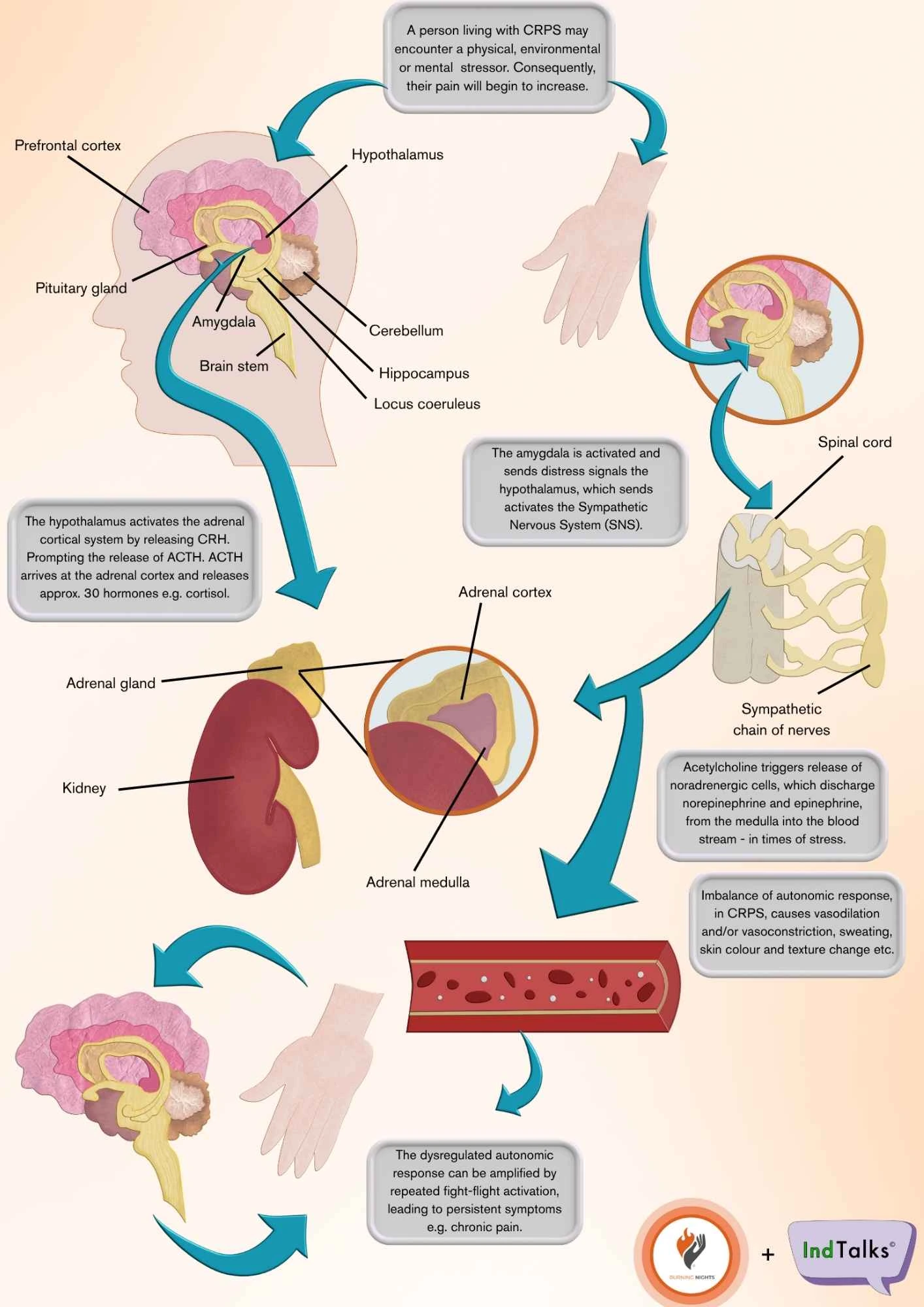
The diagram below can help to explain how Complex Regional Pain Syndrome develops and the cycle the CRPS goes in. As we have mentioned, CRPS usually begins after an injury, operation, or illness, even when that original problem seems to have healed. Instead of the pain settling down, the nerves in the affected area keep sending strong pain messages to the brain.
The brain then reacts as if the body is still in danger and switches on its “fight or flight” system. This is the body's alarm system. This can affect the nerves and blood vessels, causing swelling, colour or temperature changes in the skin and worsening pain.
These changes send even more pain messages back to the brain, creating a loop where pain and inflammation keep feeding into each other. Over time, this loop can get stuck, which is why CRPS pain can continue and become long-lasting, even without a new injury.
Find out more about the Signs and Symptoms of Complex Regional Pain Syndrome (CRPS).
Research has shown again and again that CRPS is a physical condition. It is not a mental illness, although there are unfortunately still people who believe that. Research has shown that there is no link between any psychological conditions causing the onset of CRPS. However, due to the constant high levels of pain and the issues caused within the biopsychosocial model of living with this long term condition, CRPS can go on to cause mental health issues such as PTSD, anxiety, depression, General Anxiety Disorder (GAD) and other psychological conditions.
If you are affected by mental health problems subsequent to your CRPS, please ask to be referred for counselling or the mental health team. Learn more about the various psychological treatments available for CRPS via our CRPS blog series.
Please remember that it has been proven through research that Complex Regional Pain Syndrome is a physical condition, despite what you may hear from a medical professional. Some medical professionals believe that the condition is caused by previous psychological problems, but this is NOT the case. The condition can causes future psychological problems because of the constant amount of pain. Prior psychological or mental health issues don’t predetermine CRPS. CRPS is not in your mind. It is a real physical condition.
According to the NINDS factsheet on CRPS, they state that "CRPS is believed to be caused by damage to, or malfunction of, the peripheral and central nervous systems. The central nervous system is composed of the brain and spinal cord, and the peripheral nervous system involves nerve signaling from the brain and spinal cord to the rest of the body."
Unlike other conditions and illnesses, there are not millions of pounds in Government funds or charitable donations from the public to help research the condition. This is one of the reasons why Burning Nights CRPS Support was originally founded and became a charity. If you’d like to support the work that Burning Nigths CRPS Support does please consider making a donation or setting up a fundraiser in aid of the charity. Or why not check out the many other ways of making a donation without giving money. accepts donations to help us to continue being a successful UK charity for CRPS. We also now accept both one off and regular donations via Text. To find out more about Text Donations please visit our Text To Donate page.
After being diagnosed with Complex Regional Pain Syndrome, it can seem extremely daunting and frightening, leaving you feeling vulnerable. We have produced a lot of evidence based information to help you learn about your condition, how the condition can be managed, as well as CRPS blogs helping you learn to live with your chronic condition.
Here is just a few CRPS articles for you to read:

Last Updated: 05/08/2026
We use cookies to improve your experience. By accepting you agree to our cookie policy