
 £
£
We use cookies to improve your experience. By accepting you agree to our cookie policy

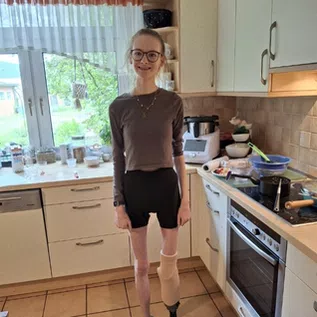
During school days of studies, friendship and growing independence, is when 13-year-old, Wiebke began feeling “unstopable and unbearable pain”.
In the month before her 14th birthday, Wiebke was kicking about a football during a friendly game in her home country of Germany until an accident occurred mid-match. “My opponent kicked me in a very unfortunate way as we were fighting for the ball. I fell down and my foot remained in the same position it had been in before.” The collision tore all the ligaments in Wiebke's foot and broke her metatarsal bones, leaving her with pain that never stopped.
Injuries like these would be expected to heal as soft tissue, bones and nerves rebuild. But the pain Wiebke was experiencing was getting progressively worse. “I was gradually less able to cope with everyday things like school, sports and housework,” said Wiekbe. “Because of the pain, I was extremely stressed. I could not cope with the fact that my body simply did not work.”
After speaking with numerous doctors, trying to make sense of what she was going through, Wiebke finally received a Complex Regional Pain Syndrome (CRPS) diagnosis, two years after the initial injury. She said: “The therapies took up most of my days, my physical condition deteriorated and I was barely able to attend school. Suddenly, I lost a lot of weight and was in an anorectic condition, which made my everyday life even more difficult.” Wiekbe had injuries to her skin and her temperature was up and down.
“At first, the pain was only in my foot,” she said. “However, during the time it took to get diagnosed and wait for treatment and therapy, my physical health deteriorated and the pain spread to my hands, shoulders, back, and arms.” Studying for exams was stressful enough – doing so while dealing with unrelenting CRPS pain is an entirely different challenge. Despite this, Wiebke’s perseverance saw her achieve her high school diploma.
On moving to Hamburg, Wiekbe began studying Electrical and Information Technology. “The dual study programme of my dreams,” she said. “I had a lot of fun, I had great colleagues and felt very comfortable, especially because I had a nice little apartment of my own.”
That Christmas, Wiebke went home to see her family, not yet knowing it was the last time she would be in Hamburg. Her health worsened, she was admitted to a hospital for over a year and had to drop out of the school she worked so hard for.
Wiebke said the hospital admission saved her life, but added: “They didn’t get my pain under control there, and the left half of my body was gradually paralysed.
“All therapies tried were unsuccessful, so I had to decide to have my left leg amputated in the winter of 2024 to 2025. The pain was hellish – I couldn’t live with it anymore, and I had to have the source of it removed.”
When Wiebke started experiencing intense pain, she naturally sought medical assistance. But the doctors she turned to for help dismissed her concerns and failed to take her symptoms seriously. She said: “There were many doctors who didn’t believe me and told me that I was imagining my horrible pain – They told me that it was a psychological problem.”
This is unfortunately all too common for people affected by CRPS. Wiebke found it difficult to find doctors who were familiar with the condition and knew how to treat it.
Upon receiving her diagnosis, Wiebke felt mixed emotions. “Relief, because I finally knew that I was not only imagining the physical problems, limitations and my worsening condition,” she said. “But also a shock, because I knew from then on that I’d probably never get rid of the pain.”
For advice on accepting and living with a diagnosis of CRPS read our article on learning acceptance with CRPS
As well as battling her own internal conflict, CRPS also took a toll on her relationships.
“I lost a lot of friends because it was hard for everyone that I was sick. I couldn’t do anything with my friends anymore and that led to friendships being broken,” Wiekbe explained.
What made her situation more difficult was that the people around her had never heard of CRPS and some didn’t believe that her physical symptoms were the result of the condition.
At home, there was heightened tension between family members, made worse by Wiebke needing round-the-clock care while also being unable to get involved in family activities. The 22-year-old said: “The hardest part of my condition was actually that I was more and more limited, and that I needed more and more help.”
Wiebke would like others without chronic pain to understand: “People with CRPS don't ask for much attention. We want to be seen and understood, but not to be the main character all the time. We try to be the best version of ourselves and do our best, even if that’s less than what others expect. We also need to rest a lot.”
Wiebke said she now has “a small and very private circle, but the best friends and my supportive and beautiful family around me”.
After her left leg was amputated, Wiebke described life as “much more pleasant” and that she is beginning “to enjoy life again”. However, she continues to experience pain and temporary paralysis in her hands, shoulders, back and arms.
She now knows her limits and when to rest but admitted: “It was still very difficult shortly after my diagnosis, as I couldn’t understand that my body is weak and needs breaks.”
Wiebke also takes regular medication and turns to heat therapy with a “wet, warm towel and massages under the heat lamp,” to ease the pain.
After searching for information about CRPS on Instagram, Wiebke discovered Burning Nights CRPS Support.
“The posts with hints and advice every day helped me to understand that I have to treat my body better,” she said. “I reposted the posts about how to handle the pain, so my friends could see what I need and how they can help and understand me.”
Had she not found Burning Nights CRPS Support through social media, Wiebke said she would have missed out on the advice and tips that the charity regularly shares to help her deal with the challenges of life with CRPS.
Wiekbe said in a message to those recently diagnosed with CRPS:
“You must never give up. Fight to be taken seriously, stand up for yourself and give your body the peace you need. You can do this if you know, keep and accept your limits. Seek help, both psychologically and physiologically.
“You are not alone – we CRPS Warriors stick together.”
To read more CRPS personal stories like Wiebke's and to stay up to date on CRPS news, information and events, sign up to our free e-newsletter.
To help reach more people living with CRPS with information and support, why not make a donation? You can help raise awareness for CRPS with just £5 a month. Donate today.
We use cookies to improve your experience. By accepting you agree to our cookie policy