 £
£
We use cookies to improve your experience. By accepting you agree to our cookie policy
In the UK, the Equality Act 2010 provides the main legal protections around toilet access for people living with a disability. This law exists to ensure people with a disability have the same level of access to toilet facilities as able-bodied people in public buildings, and makes discrimination against people with a disability illegal. The act states that service providers have a duty to make reasonable adjustments to achieve this. The law also made accessible toilets a requirement in buildings the public has access to. This includes but is not limited to government buildings and shopping centres.
However, there is no legal obligation for businesses to provide toilets to non-customers, as long as they do so consistently and without prejudice. The Equality Act 2010 simply states that people with a disability have equal access to toilets as able-bodied people, it does not state that access to every toilet is a legal right.
Many people living with CRPS experience bladder and bowel issues, making urgent access to a toilet critical. Although businesses are under no legal obligation to allow use of their toilet to the public, many allow access if you present them with a toilet priority card.
For example, the ‘Just can’t Wait’ card is offered by The Bladder & Bowel Community charity. After registering with the charity, you can access a free digital card to add to Apple Wallet or Google Wallet or choose to purchase a plastic card for £3.95 from their website. The card is recognised by many retailers and service providers and communicates your medical need and urgency for the toilet. Showing a toilet card can make difficult conversations easier and increase the likelihood of being allowed to use facilities that are not normally open to the general public.
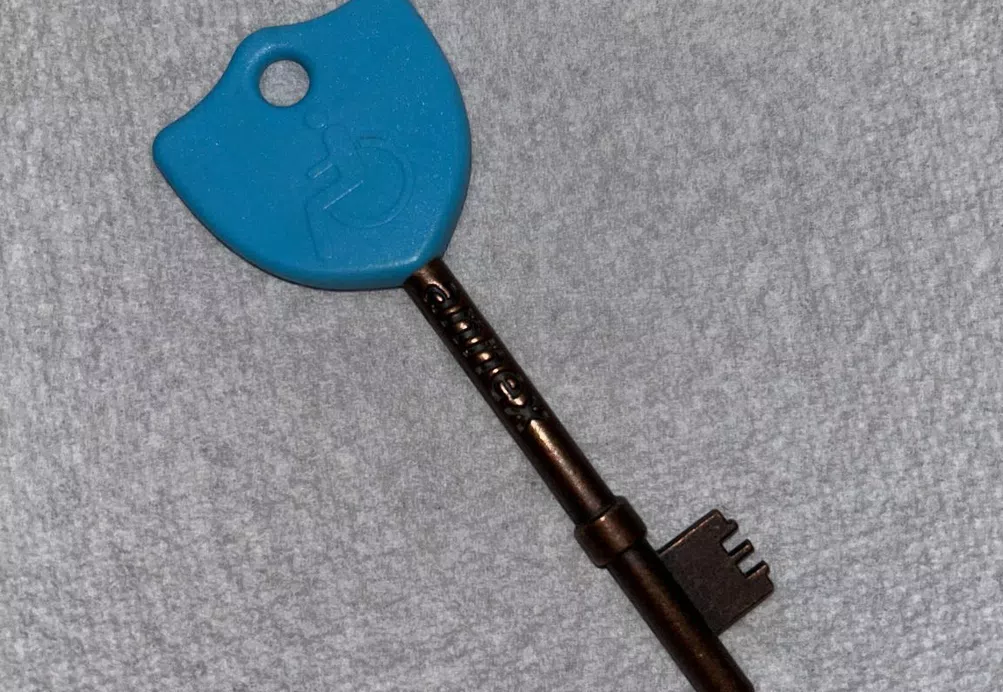
In the UK, you can purchase a RADAR key in order to access public bathrooms that are normally locked. The RADAR key is part of the National Key Scheme, a UK-wide system that allows people living with a disability to independently access locked accessible toilets. The scheme was first introduced in 1981 by the Royal Association for Disability and Rehabilitation (RADAR), which later became part of Disability Rights UK.
Today, over 400 local authorities participate in the scheme. Standardised locks are fitted in accessible toilets, which can then be opened with a single universal key. This gives key holders access to around 10,000 locked disabled toilets across the UK, including more than 1,000 Changing Places toilets.
Many accessible toilets are locked to protect them from vandalism or misuse, and in many locations a RADAR key is the only way to gain access. In some venues, such as pubs or cafés, staff may hold a key behind the counter so feel free to ask if you do not have your own. For people with CRPS, the RADAR key can be life-changing. It offers privacy, independence, and reassurance, particularly when symptoms flare unexpectedly or mobility is limited.
Some local authorities provide RADAR keys free of charge or at a reduced cost, but where this is not available, keys can be purchased at a low price. Disability Rights UK sells RADAR keys for around £5.
Although RADAR keys are also sold online through other retailers such as Amazon, these may not always be genuine. To avoid fakes and incompatible keys, buy directly from Disability Rights UK.
Some charities, particularly those supporting people with bowel and bladder conditions, may provide a RADAR key for free as part of membership. This includes charities such as the Bladder & Bowel Community and Crohn’s & Colitis UK.
While anyone can buy a RADAR key and no proof of disability is required, the scheme relies on trust. Keys should only be used by people with a disability – misuse stops someone with genuine need from accessing vital facilities.
If your disability is not visible and you are concerned about being challenged while using an accessible toilet, a Hidden Disabilities Sunflower lanyard can help signal that you have a legitimate need. It’s important to remember that you are entitled to use accessible toilets regardless of whether your disability is obvious to others.
There are also helpful apps that can make planning easier, such as Changing Places Toilet Finder, which shows whether a RADAR key is needed, and Flush, which lists public toilets across the UK. The RADAR key itself only works in the UK, but apps like Toilet Finder can help locate accessible toilets when travelling abroad.
We use cookies to improve your experience. By accepting you agree to our cookie policy